
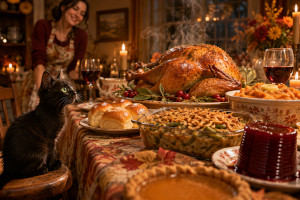
 On the morn of which I write, the mistress rose before the sun, which is most suspicious, for witches are known to labor in the dark hours. She went into her kitchen, which I now understand to be her sanctum, and she took from her cold cabinet a great pale beast of a bird, plucked bare and trussed with twine.
A sacrifice, I thought, and my whiskers trembled.
She laid it upon the counter and rubbed it with butter and herbs. Sage, rosemary, thyme. I know these herbs well, for in my first life the village cunning-woman used the very same in her charms. She spoke over the bird in low murmurs, though I could not discern the incantation. Then she opened a hot iron door in the wall, and the bird went in. The door closed upon it. The deed was done.
I sat upon my stool of observation and said not a word, for I am discreet. But I confess my heart beat a drum.
For hours the sanctum filled with an aroma so divine that I forgot my fear. Though I understood this to be the smell of a ritual, it was also, I must admit, the smell of paradise itself. Surely the dark arts have never smelt so fine.
By the afternoon, the witches and warlocks began to arrive. First came a tall warlock in a woolen garment, bearing a dish covered in shine. Then a witch with a laughing child upon her hip, and another carrying a pie. Then came more, and more, until the house was thick with them. By my count there were eleven souls, and I do believe two were of an age near to ancient.
They embraced and spoke in loud and merry tongues. They carried strange gifts: green beans swimming in a creamy sauce, orange mashed roots, little rolls soft as clouds, and a jellied red substance that held the shape of the very tin it came from. Cranberry, they called it. I name it witches' blood-jelly, and I shall hear no argument.
The warlock with the woolen garment approached me and said, "Hey, buddy, who's this?" and scratched me beneath the chin. I permitted it. One must show courtesy to the high priest of the gathering, lest he turn one into a toad.
At last the mistress drew the great bird from the iron door, golden-brown and glistening, and set it at the center of a long table. The coven fell silent. Hands were joined. Heads were bowed.
Here it comes, I thought. The invocation.
And indeed, one by one, each witch and warlock spoke aloud of things they were grateful for. The old one gave thanks for her health. The child gave thanks for "dinosaurs and Grandma." The warlock in wool gave thanks for "good food and better company," whereupon all raised their glasses of dark red wine and murmured agreement.
I confess, dear reader, I had expected a darker liturgy. I had braced myself for chanting, for dancing about a bonfire, for a goat perhaps. Instead I found a circle of folk giving thanks and speaking kindly to one another.
Then the warlock took up a long blade and carved the sacrificed beast into pieces, and the whole coven feasted upon it.
I am a cat of sophistication, yet I will tell you I wept a little at the injustice of it. For in the whole of that long night, not a single morsel did I receive from the table, though I wound myself about the ankles of seventeen different shoes. Seventeen. I counted.
Yet all is not lost, for the mistress is wise and kind, as the best witches are. When the feast was ended, and the coven had gone sleepy and slow by the glowing hearth-box, where tiny men chased a leather ball across a green field, she crept to my dish and placed within it a small shred of the sacrificed bird, warm and tender.
I ate it in four bites, and I forgave her everything.
So here is my conclusion, set down by candlelight, or rather by the cold white glow of a lamp that needeth no flame.
I know not what manner of coven this is. I know only that its witches feed the hungry, embrace their kin, and give thanks before they eat. If this be witchcraft, then I say let the old Inquisitors come, and I shall hiss at them from beneath the mistress's skirts.
I remain, as ever, her faithful familiar.