
 Усы и Ваттс.
It was November 10, 2001. Under a flickering lamp in the hangar, Engineer Grigoriy slid out from beneath the vehicle with grease on his whiskers. “E.G., the last mission really cooked the inverter.”
The inverter power module was cracked and blackened. The nuclear battery hummed behind it, steady and patient, but the inverter couldn’t turn that steady power into something the motors could use. Without it, the nuclear output is limited to twenty-five percent, and most importantly, rapid acceleration needs to be disabled.
“We can’t replace it,” Engineer Grigoriy said. “We need to completely rebuild it.”
Technician Grigoriy tapped his whisker thoughtfully. “Then we don’t ask it to do everything. We split the load.”
They worked through the week. Technician Grigoriy soldered a bank of capacitors that he found at a military base, across the new module to smooth the surges.
Engineer Grigoriy installed a heat sink and bolted it to the casing to pull the heat away.
At dawn, they powered it up. The inverter purred and the cloak shimmered on, then settled.
“Stable,” Engineer Grigoriy whispered.
Boots thumped on the concrete. Commander Grigoriy inspected the vehicle in silence. “Will it hold all the way to Volcano Village?”
Engineer Grigoriy and Technician Grigoriy exchanged a look.
“On paper, yes,” Technician Grigoriy said carefully. “But we've never put this type of module to the test. We recommend an extreme stress test in an isolated location first.”
“Saddle Road,” Technician Grigoriy added. “Long climbs, hard acceleration, cold air at altitude. If the repair survives that, it will survive the trip to Volcano.”
The Commander stroked his chin, then nodded. “Saddle Road it is.”
Technician Grigoriy climbed into the driver’s seat and Engineer Grigoriy took the monitoring console, his paw hovering over the inverter’s temperature readout.
The thrusters hissed, and the vehicle vanished into the morning.
The hangar door rolled up on a gray morning, and the vehicle slipped out with the cloak on, leaving only a faint ripple.
“Inverter temperature?” Technician Grigoriy asked, gripping the wheel.
“Forty-one degrees,” Engineer Grigoriy said. “Calm as a sleeping cat.”
“Don’t say cat.”
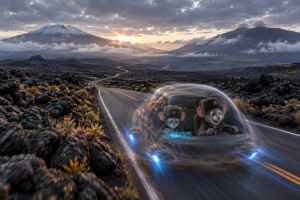
By the time they reached the base of Saddle Road, the air had thinned and cooled. Lava fields stretched away on both sides, black and jagged, with Mauna Kea rising on one side and Mauna Loa on the other. A truck rumbled past, and the driver never noticed the two mice gliding beside him.
“Cloak is holding,” Technician Grigoriy reported. “Capacitors are smoothing the surges.”
“Then let’s see what it can do.”
Technician Grigoriy opened the throttle. The nuclear battery fed the inverter, the inverter fed the motors, and the vehicle surged toward 160 kilometers per hour. At the first steep grade the inverter climbed to fifty-eight degrees, and Engineer Grigoriy’s paw tightened on the console.
“Sixty-two. We're using the full power of the engine. Heat sink is working.”
Near the summit of the road, the wind turned bitter. Frost crept along the windshield. Cold air did what no workshop test could.
They ran the full stretch, accelerating, climbing, braking, accelerating again, drawing on the battery for mile after mile. When they finally pulled onto a gravel turnout and shut down, the cloak flickered off with a soft chime, and not once had it faltered.
Technician Grigoriy leaned back in his seat, whiskers trembling. “Total distance?”
“Forty kilometers,” Engineer Grigoriy said, checking the log. “No faults. No flickers. Peak inverter temperature, Sixty-four degrees.”
They sat quietly for a moment, listening to the engine tick as it cooled and the wind whistle across the lava.
“We should tell the Commander,” Technician Grigoriy said.
Engineer Grigoriy took the wheel and they returned to base.
Миссия выполнена.