
 The best trial on television isn’t about the verdict.
Television loves a courtroom. For decades, it has given us dramatic confessions, objections delivered with a flourish, and juries that gasp on cue. Most courtroom dramas follow a familiar logic: a mystery is solved, a lie exposed, and justice either triumphs or fails. The best, from the legal chess matches of The Good Wife to the moral rot of Better Call Saul, understand that a trial is never just about the law. It is about who can control the story.
But the trial of Will Graham in the second season of Hannibal goes somewhere darker. It is not really a trial at all. It is a séance, a seduction, a magic trick performed in a room built on the comforting fiction that truth is something a process can uncover.
The Defendant Knows Who Did It
Most courtroom dramas preserve their central question until the final act: Did he do it? Hannibal dispenses with the mystery almost immediately. We know Will is innocent. We know Hannibal Lecter is the Chesapeake Ripper. We know Hannibal has concealed and exploited Will’s neurological illness, helping to engineer the very circumstances that now make him look guilty.
The question, then, is not whether the truth will emerge, but whether the truth has any power to save him.
Will stands accused in a system designed to evaluate evidence, testimony, and expertise. Every one of those instruments has been compromised by the actual killer. The crime scenes have been arranged to implicate Will. His medical history has been manipulated. The experts whose authority should clarify the facts have been charmed, cultivated, or outmaneuvered by Hannibal.
The result is a courtroom drama in which the machinery of justice works exactly as intended—and produces a lie.
The Witness Stand as a Stage
Hannibal’s genius is that he rarely needs to lie outright. He is poised, empathetic, precise. He speaks about Will with what appears to be genuine sorrow, offering the court the portrait of a troubled friend rather than a predator describing the wreckage he has engineered.
For the audience, the effect is almost vertiginous. We know what the courtroom cannot see: every gesture is calculated, every expression of concern another instrument of control. Hannibal’s testimony is chilling not because it is transparently false, but because it is so effortlessly believable.
Mads Mikkelsen is the scene’s quiet engine. He never plays Hannibal’s composure as obvious villainy. He plays it as care. The horror lies in the gap between what we know he has done and what everyone around him believes he feels. When the man responsible for your destruction looks at you with apparent grief, the cruelty is not merely that he is lying. It is that the room has every reason to believe him.
Hugh Dancy, meanwhile, plays Will as a man coming apart in public. A lesser show might give its hero a stirring speech, some eloquent declaration that forces the room to confront its mistake. Hannibal offers no such consolation. Will is exhausted, volatile, and increasingly difficult to believe. His distress is real, but the more visibly he suffers, the easier he becomes to dismiss.
His empathy, the very quality that made him invaluable to the FBI, has become evidence of his instability. The institution rewards composure and mistakes it for credibility. Will cannot make himself legible to a system that has already decided what he is.
A Courtroom Inside a Mind
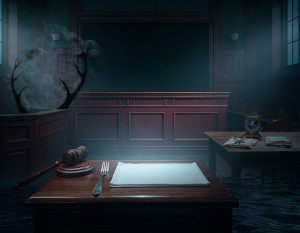
The trial’s visual language makes this crisis of credibility almost physical. Hannibal is among television’s most visually audacious dramas, and the courtroom offers its surrealism a particularly potent setting. As Will’s perception fractures, testimony distorts, figures shift, and the boundary between external events and internal terror begins to dissolve.
In most courtroom dramas, the room is a machine for imposing order. In Hannibal, it becomes another of Will’s unstable landscapes: a place where appearances harden into facts and the truth grows less accessible the more formally it is examined.
The surrealism is not ornamental. It gives visual form to the trial’s underlying question: whose version of reality will prevail? The answer has less to do with who possesses the facts than with who has the authority to make those facts believable.
Hannibal understands this instinctively. He does not merely manipulate evidence; he manipulates the conditions under which evidence is interpreted. He knows that credibility is not distributed equally, that expertise can be performed, and that a convincing account of reality can matter more than reality itself. His real talent is not simply getting away with murder. It is making the truth sound delusional.
Why It Beats the Competition
Fictional trials often derive their power from resolution. A brilliant lawyer exposes the decisive contradiction. A witness breaks down. A speech restores moral clarity, even when the verdict disappoints. In To Kill a Mockingbird, Atticus Finch’s eloquence cannot overcome the prejudice of the jury. In Hannibal, the problem is more intimate and perhaps more frightening: the person who knows the truth is also the person least capable of making it credible.
That is what makes Will’s trial so unsettling. It denies us the reassuring distance of a procedural puzzle. There is no mystery for the audience to solve, no hidden clue that will suddenly make everything right. We know what happened. We know who is responsible. We watch anyway, helpless as the truth is buried beneath a more persuasive fiction.
The sequence also places unusual demands on its audience. It asks us to hold two realities in mind at once: the facts as we know them and the version the courtroom is prepared to accept. Suspense emerges not from uncertainty about guilt, but from the widening gulf between knowledge and belief. We are not waiting to discover the truth. We are waiting to see how thoroughly it can fail.
Great courtroom television asks whether justice will be served. Will Graham’s trial asks a more disturbing question: what happens when the person responsible for the crime is also the person best equipped to define reality?
In Hannibal, justice does not simply fail to find the truth. It becomes the instrument through which the truth is discredited. The verdict matters less than the spectacle of its production: a room full of reasonable people, following reasonable procedures, arriving at an unreasonable conclusion.
The most frightening thing about Will Graham’s trial is not that the system can be fooled. It is that, from inside the courtroom, the lie looks so much like justice.