
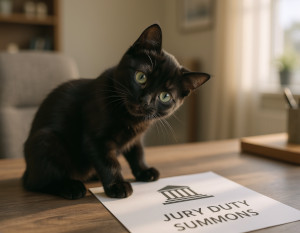
 On a gray morning, I saw my mistress in great agitation. She paced the chamber. She muttered. She clutched a parchment, stamped with a seal of dire import, and read it over and over as though it might change its runes.
I leapt upon the table to inspect it, for I am a cat of keen intellect. She did not shoo me away, which told me the matter was grave.
"Jury duty," she sighed. "Tomorrow. Half past eight in the morning."
I know not what a "jury" may be, nor a "duty," but I understood the tone. It was the tone my old master used when the tax collector's reeve came to the mill.
From her murmurings I pieced together the truth of it. A powerful warlock, a great and terrible sorcerer who sitteth upon a high seat, had summoned her. Not by raven, nor by messenger, but by parchment and by decree. And she, a sorceress of no small power herself, must obey.
I arched my back and hissed at the parchment. It did not hiss back, which I took for cowardice.
I have since gathered that this warlock is called a "judge," and that his domain is a great stone hall with benches, where he presideth. Never in my lives, have I beheld a sorcerer who commanded such obedience. Kings I have known, and bishops, but this warlock hath only to send a paper, and the whole countryside troopeth to his hall.
And what do they bring him? Their time. He demandeth it, drawn from the people like blood from a leech. In return he giveth them "small change."
My mistress, in her fretting, spake aloud to her glowing slate, and I overheard the terms of the summons. Should she fail to appear, a "warrant" may be issued, and she may be "arrested," carried off in chains of steel by the warlock's men in their blue-and-white carriages.
Think upon it! She hath committed no crime. She hath stolen no sheep, poisoned no well, whispered no heresy. She is the very picture of innocence, a woman who feedeth her cat on time and payeth her debts. Yet if she doth not present herself to the warlock's hall, she may be thrown into the dungeon.
In my old life, I saw many a thing at the market square. A man might be dragged before the magistrate for a stolen loaf. And if a fellow was summoned to the manor court and failed to appear, why, the bailiff would seize his goods or clap him in the stocks. So it is not so different, I grant. But in my day, at least, the summons was for those accused. Here, the innocent are the ones summoned, and they are threatened with the very gaol they are sent to guard against.
It is a cunning sorcery indeed, to conscript the blameless and bind them by fear.
Let me tell thee, how justice was done in the 1500s, when I first walked the earth.
If a man were accused of a crime, he was seized by the constable and hauled before the justice of the peace. There was no great gathering of strangers to weigh his fate. The matter was often settled by the magistrate's word, by the testimony of neighbors, or, in darker cases, by trial of ordeal.
Punishments were swift and public. The stocks for the petty thief. The pillory for the liar. The whipping post for the vagabond. And for the gravest crimes, the gallows at the crossroads, with the whole village in attendance and a goodwife selling pies.
Now compare this to my mistress's coming ordeal. In the modern hall, the accused sitteth in comfort, with a learned advocate to speak for him. Ordinary folk are chosen to hear the tale and weigh it with their reason.
I confess it is gentler than the old way. Yet it taketh far longer, and my mistress shall be gone from her hearth, and who then shall open the pouch of food?
On the morn appointed, my mistress rose before the sun. She donned her sober garments and combed her hair. She filled my bowl, thank the stars, and scratched behind my ears, for she is a kind witch despite her terrible powers.
"Be good, Perkins," she said. "I may be stalked and whipped by the defendant's supporters tonight."
Pursued like a hare and whipped besides? Foul is the warlock who alloweth it, and fouler still his heart!
She took up her satchel and her keys, those jingling talismans of power, and went to the door. I sat upon the sill and watched her climb into her iron carriage, which roareth to life without horse or whip. It rolled away down the lane, belching its strange breath into the morning air.
I watched until it vanished. Then I turned to the empty house, and my heart was heavy.
So here I sit, upon the windowsill, in the pale light of a dying sun, keeping watch as a faithful familiar should.
I shall not sleep. I shall not stray. I shall keep the hearth against all comers, and should any mouse dare show his whiskers, he shall learn that Perkins, the black cat of Kent, hath lost none of his cunning in the centuries.
And when my mistress returneth, as I pray she shall, I shall meet her at the door, and wind about her ankles, and she shall know that I held my vigil true. Then perchance she shall tell me what befell her in the warlock's hall, and whether the twelve did weigh a soul that day.
For I am Perkins, and I have lived twice, and in both lives I have learned this: the powerful summon, the humble obey, and the cat watcheth from the window, thinking what he thinketh.