
 When last I closed mine eyes to nap, the dwelling was a very sabbath of horrors. From the rafters dangled a skeleton, grinning without lips. Webs of white thread draped every corner, and fat spiders, black as mine own self, crouched upon them. A cauldron sat upon the table, belching mist, and a pumpkin with a carven face leered at me from the windowsill by the dim orange light of a dozen false flames. I confess I grew fond of the skeleton, whom I called Sir Bonesworth, and I did bat at his dangling foot with great diligence.
Then I slept. A single afternoon, I swear it upon my whiskers.
I awoke upon the sofa and knew at once that something was amiss.
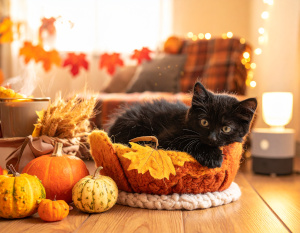
Sir Bonesworth was gone. In his stead hung a garland of leaves, red as a robin's breast and gold as a harvest moon. The cobwebs had vanished, every thread. The orange glare had softened to a honeyed amber that made the whole room glow like the inside of a loaf of new bread. Upon the table, where the cauldron had belched, sat a basket of little gourds, speckled and striped, with a sheaf of dried wheat tied in ribbon beside them. A blanket of woven plaid lay across the sofa, warm as a sunbeam. And the air! The air smelled of cinnamon and baked apples, wafting from a small vessel that melteth wax with no fire whatsoever.
I sat upon the rug and stared, and my tail puffed to twice its size.
The whole dwelling, changed from a haunt of the dead to a cottage of the harvest, between one nap and the next. No mortal hand could do such a thing, not in a single afternoon. Mistress must have wrought some powerful magic. Perchance she spoke a word of power to the cylinder. Perchance she waved her hand over the room and the very spirits of autumn obeyed. I searched for the cauldron of her spell and found only a cardboard box in the cupboard, marked in her runes, and that proveth nothing, for a clever witch doth hide her instruments well.
Then she entered, my Mistress, a mug of steaming brew in hand, humming a tune with no lute to carry it. I arched my back and hissed, as a cat of honour must when confronted by sorcery of such magnitude.
She merely laughed and said, "Perkins, do you like it? Isn't it cozy?"
And she scooped me up. Not with a broom, mind you. Not with a curse. She tucked me beneath her chin, and she scratched that spot behind mine ears which no one in the whole sixteenth century ever once discovered. She set me down upon the plaid blanket, and beside it, wonder of wonders, she had placed a small bed lined with leaf-coloured wool, just my size.
Then she drew a morsel of fish from a pouch and laid it before me.
I considered the matter gravely. In my first life, a witch was a thing to be feared, and a black cat was a thing to be burned. Yet in this life, the witch feedeth me fish, warmeth my bed, and calleth me by name with great tenderness.
If this be witchcraft, then let the village keep its brooms.
I ate the fish. I curled into the little bed, green eyes half closed, and the amber lights glowed above me. And I decided, upon the whole, that I shall remain the familiar of this most powerful and most generous witch for as many lives as the Fates may grant me.